

A production-grade AI system that reclaimed 225+ editorial hours annually without disrupting publishing speed.
Executive Summary
A large, high-volume content organization was facing a familiar problem: speed was critical, but SEO quality directly determined performance. Journalists and editors were under constant pressure to publish faster than competitors, while SEO tasks – titles, meta descriptions, and tagging – remained manual, inconsistent, and often deprioritized.
Ordinate AI designed and implemented a set of AI-powered recommenders embedded directly into the existing editorial workflow. The system automated the generation of SEO titles, meta descriptions, and tags – without disrupting how journalists work or compromising editorial control.
The result was a dramatic reduction in manual effort, consistent SEO quality across the newsroom, and measurable improvements in operational efficiency and content performance.
The Challenge: Speed Wins the News Cycle, SEO Wins the Long Game
In high-velocity newsrooms, publishing speed is non-negotiable. Articles must go live immediately – often before full optimization is possible. SEO tasks are frequently handled under time pressure, delegated to non-experts, or skipped entirely.
Key challenges included:
- Manual SEO work slowing down publishing
Writing SEO titles, descriptions, and tags added friction to an already time-critical workflow. - Inconsistent SEO quality
Journalists are not SEO specialists, leading to variability in quality and missed ranking opportunities. - Parallel work at scale
Dozens of journalists working simultaneously increased the risk of errors, duplication, and inconsistency. - A gap between SEO best practices and real workflows
Guidelines existed—but were not embedded into day-to-day editorial tools.
The business impact was clear: slower publishing, inconsistent visibility, and underperformance on the single most important metric – Page Views.

The Approach: AI Where It Matters, Not Where It Distracts
Ordinate AI started by analyzing the real editorial workflow—how articles are created, edited, and published under pressure.
Instead of introducing a separate AI tool, we embedded intelligence directly into the CMS, focusing on the moments where friction already existed.
The solution consisted of three tightly integrated AI components:
- SEO Title Recommender
Generates multiple SEO-optimized title suggestions based on article content, aligned with editorial tone and SEO best practices. - SEO Description Recommender
Automatically proposes meta descriptions that are concise, keyword-aware, and search-intent driven. - Tag Recommender
Suggests the most relevant, standardized tags to improve internal search, topic clustering, and long-term SEO structure.
Editors retain full control – AI provides high-quality recommendations, not final decisions.
Built for Real-World Editorial Constraints
The system was designed around one core rule: never slow journalists down.
- AI suggestions are generated on demand or automatically when fields are left empty.
- Recommendations appear inside the existing CMS interface—no context switching.
- Outputs are editable, reviewable, and aligned with editorial responsibility.
- Performance was optimized to deliver results within seconds—crucial in breaking-news scenarios.
This ensured immediate adoption without retraining or workflow disruption.
The Solution: A Modular AI Architecture Embedded Into the CMS
Ordinate AI engineered a modular AI service designed to operate as a native extension of the CMS, optimized for low latency, high concurrency, and production reliability.
When an article is created, the CMS sends structured content inputs to a dedicated AI service through an API Gateway. The service orchestrates multiple AI pipelines in parallel, each optimized for a specific task within the editorial workflow.
SEO titles and meta descriptions are generated using a production-optimized Large Language Model (LLM), guided by system-level constraints to ensure consistency with editorial tone, SEO length requirements, and publishing standards. Outputs are generated deterministically within defined boundaries and remain fully editable by editors.
For tagging, the system combines semantic and symbolic approaches. Article text is transformed into vector embeddings and matched against an indexed tag corpus using a high-performance vector database. In parallel, a Named Entity Recognition (NER) model extracts entities such as people and locations, which are matched against existing taxonomy structures.
Results from semantic similarity search and entity matching are aggregated and ranked, then passed through a final AI-based filtering stage, reducing a large candidate set to a concise, high-confidence tag list.
The architecture is stateless, horizontally scalable, and designed with strict latency and cost controls, ensuring stable performance under sustained editorial load.
The Impact: Measurable Gains, Immediately
The results were both operational and strategic.
Key Outcomes
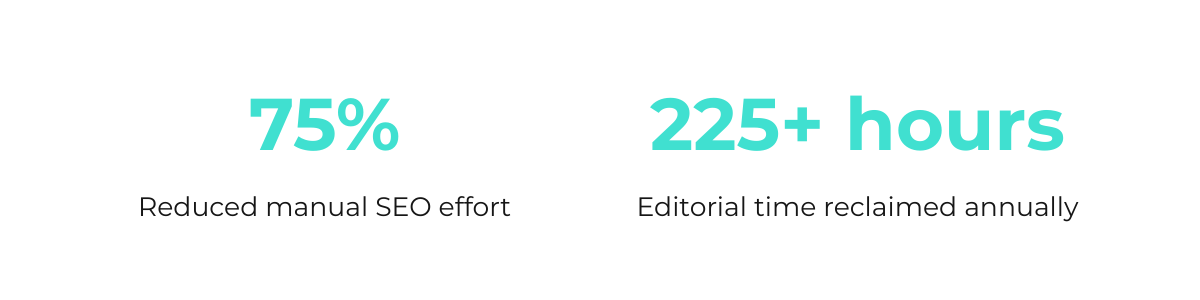
- Reduced manual SEO effort by up to 75%
Combined time for titles, descriptions, and tags dropped from ~60 seconds per article to under 15 seconds. - 225+ hours of editorial time reclaimed annually
For a newsroom publishing 50+ articles per day. - Consistent SEO quality across all content
Best practices applied automatically, regardless of author or time pressure. - Faster publishing without sacrificing performance
Speed and SEO no longer competed—they reinforced each other.
Why This Matters Beyond the Newsroom
What began as an internal efficiency improvement quickly revealed broader value.
By embedding AI into core publishing workflows, the organization didn’t just optimize content—it created a scalable capability:
- A CMS differentiated by intelligent automation
- Higher organic reach without additional editorial cost
- A foundation for future AI-driven content features
This was not a feature experiment—it was a production-grade system designed for scale.
From Operational Fix to Strategic Asset
Every AI system we build is designed with a product mindset.
In this case, the result was more than reclaimed time. It was a repeatable, scalable approach to applying AI where it delivers immediate business value—closing the gap between editorial speed, SEO quality, and long-term growth.